
Greek group lessons vs private classes:
which is right for you?
The complete guide to choosing between Greek group lessons and private classes with real pricing, student experiences, and honest pros & cons
You’ve decided to learn Greek. Congrats!
Now comes the next question: should you learn one-on-one with a teacher, or join Greek group lessons?
It’s a common dilemma. Private lessons sound appealing: just you and the teacher, fully personalized attention. However, they’re also a significant investment, and if you’re honest, the idea of learning completely alone feels a bit… isolating.
Group lessons, meanwhile, offer something different: learning alongside people who share your goals, built-in accountability, and the kind of camaraderie that makes the whole journey more enjoyable (and way more affordable).
Here’s the truth: for most Greek learners, group lessons aren’t just “good enough”—they’re actually better. Better for building real conversational confidence. Moreover, they’re better for staying motivated long-term, and better for creating the kind of practice that prepares you for actual conversations with Greeks.
That said, group lessons aren’t for everyone. Some students have unique needs that make private instruction the right choice—and that’s completely okay.
In this post, I’ll show you exactly why Greek group lessons work so brilliantly for most learners, when private lessons make more sense, and how to decide which format will help you actually master Greek instead of giving up after a few months.
What are Greek group lessons, really?
Let’s clear up what we mean by “group lessons.” I’m not talking about massive classrooms with 20 students where you sit in the back and never speak.
Greek group lessons (done right) are small, intimate classes with 2-4 students maximum. Everyone is at the same level (A1 beginners together, B1 intermediate together, etc.), and you meet weekly for a structured course of 12 weeks.
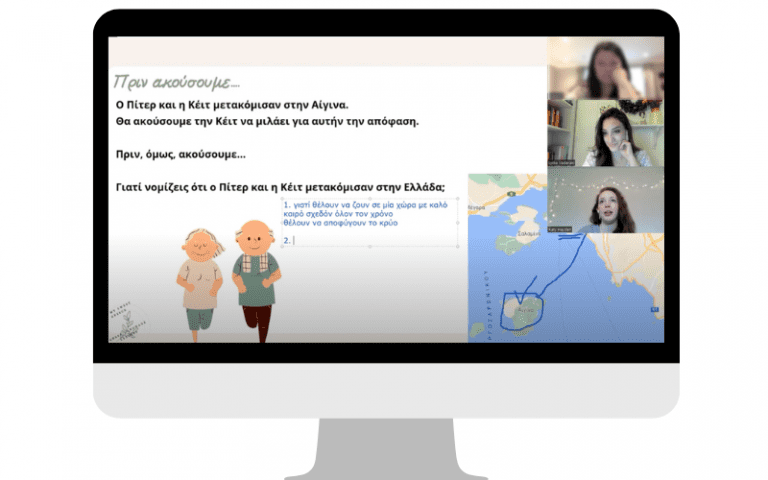
The teacher designs lessons that encourage interaction: partner activities, role-playing real scenarios and group discussions. You’re not just listening to a lecture; you’re practicing Greek with peers who understand exactly what you’re going through because they’re on the same journey.
Think of it less like “school” and more like “group coaching.”
The surprising benefits of Greek group lessons
Here’s what nobody tells you about learning Greek in a group – the benefits go way beyond “it’s cheaper.”-.
1. You're not alone in the struggle
Learning a language can feel incredibly lonely. You’re making weird sounds, forgetting words mid-sentence, and wondering if you’ll ever stop translating in your head.
In Greek group lessons, everyone else is struggling too. Surprisingly, that’s oddly comforting.
When someone else asks, “Wait, why do we use the accusative here?” you realize you weren’t the only one confused. Similarly, when your classmate nails a tricky pronunciation after three tries, you’re inspired to keep going. When you all laugh about mixing up “παίρνω” (I take) and “περνάω” (I pass), the embarrassment melts away.
You’re not just learning Greek, you’re learning it together. That shared experience creates motivation, accountability, and genuine connection.
2. You learn from other students' mistakes (& questions)
In private lessons, the teacher only corrects your mistakes. In contrast, in Greek group lessons, you hear everyone’s mistakes and learn from them without having to make them yourself.
For example, someone asks about the difference between “θέλω” and “θα ήθελα”? Boom, you just learned something you didn’t even know you didn’t know.
Likewise, someone struggles with a verb conjugation? The teacher explains it three different ways until it clicks—and one of those explanations will resonate with you too.
In essence, you get 3-4x the learning opportunities because you’re absorbing corrections, explanations, and examples meant for others, not just yourself.
Oh my sweet Greece really helped me start speaking in Greek class. Mini-group classroom dynamics with Katerina are lively and engaging and study materials are customized after each class to reinforce what was learned, talked and asked about. Glad I found this program!
Anali, A1 Greek group class
3. Real conversation practice (not just teacher-student)
Here’s the uncomfortable truth about private Greek lessons: most of your speaking practice is artificial.
You’re talking to your teacher, someone who already knows Greek perfectly, who’s patient, who slows down for you. That’s helpful, but it’s not realistic.
On the other hand, in Greek group lessons, you practice with other learners. And that’s messy, awkward, and exactly what you need.
You stumble over words together. Additionally, you negotiate meaning when someone uses the wrong tense. You learn to be patient, to rephrase, to figure things out—just like you’ll have to do in real conversations with Greeks.
Finally, this is how you build conversational resilience, not just language knowledge.
4. Friendships & community
Let’s be honest: learning Greek as an adult can feel isolating, especially if you’re an expat in Athens or learning from abroad.
Greek group lessons give you instant community. You meet people who share your goals, understand your frustrations, and celebrate your progress.
In fact, many of our group students become friends outside of class. They:
- Practice Greek together via WhatsApp between lessons
- Plan trips to Greece together
- Meet for coffee to study
- Support each other through plateaus and breakthroughs
You’re not just taking a course. You’re joining a community.
I joined Greek group lessons thinking I'd just learn faster. What I didn't expect was making real friends. We still text in Greek, share memes, and plan to visit Crete together next summer.
Lisa, B1 Greek group course

5. It's more affordable (without sacrificing quality)
Let’s talk money. Private Greek lessons typically cost 2-3x more than group lessons because you’re paying for 100% of the teacher’s time.
Greek group lessons split that cost across 2-4 students, making quality instruction accessible even if you’re on a budget.
Here’s how the pricing actually breaks down:
Private Lessons (1-on-1, 55 minutes):
- Levels A1-A2: €145 for 5 lessons | €275 for 10 lessons | €520 for 20 lessons
- Levels B1-B2: €160 for 5 lessons | €290 for 10 lessons | €540 for 20 lessons
For 12 lessons: approximately €330-380 depending on package & level.
Group Lessons (2-4 students, 75 minutes):
- 12-week course (12 x 75-minute lessons): €228
That’s less than €20 per lesson – and you get 20 extra minutes per class!
The savings? Group lessons cost about 30-35% less than private lessons and you still get the same qualified native teacher, the same high-quality curriculum, plus the bonus of conversation practice with peers who are learning alongside you. For many learners, that combination of affordability and community is a total game-changer.
The hidden benefits of Greek group lessons nobody talks about
Beyond the obvious (affordability, community), here are some surprising advantages of learning Greek in a group:
1. You see multiple learning strategies (and find yours)
Every student in your group learns differently. For instance, one person uses flashcards religiously. Another watches Greek TV shows, meawhile someone else practices by talking to themselves while cooking.
You’ll steal the best strategies from everyone. What’s more, the teacher might explain a grammar concept three different ways for three different students—and one of those ways will finally make it click for you too.
2. You build confidence faster
Here’s a secret: speaking Greek to a teacher (who’s endlessly patient and never judges) doesn’t build the same confidence as speaking to a peer (who’s also nervous and making mistakes).
When you successfully communicate with another learner—negotiating meaning, figuring things out together—you prove to yourself: “I can actually do this with real people, not just my teacher.”
That confidence transfers directly to speaking with Greeks.
3. You're less likely to quit
Most people who start learning Greek alone quit within 3 months. Why? Lack of accountability and motivation.
However, in group lessons, you don’t want to let your classmates down. You show up because Maria and John will notice if you’re gone. You do your homework because you’ll discuss it together.
In short, the social commitment keeps you going when motivation dips.
When do some students choose private lessons?
Greek group lessons work brilliantly for most learners, however some students have unique circumstances that make private lessons a better fit not because group lessons aren’t effective, but because their situation requires a different format.
1. Unpredictable schedules
Group lessons meet at a fixed time every week for 12 weeks. If your work involves constant travel, rotating shifts, or unpredictable emergencies, you might struggle to commit to a set schedule.
That said: Many busy professionals make group lessons work by blocking out that one hour per week as sacred. In fact, the fixed schedule actually helps them stay consistent instead of constantly rescheduling.
2. Specific professional needs
If you need Greek for a very niche purpose (legal terminology for court interpreting, medical Greek for healthcare professionals, or academic Greek for research) private lessons let you skip general topics and dive straight into specialized vocabulary.
But here’s the thing: Most learners don’t need this level of specialization. If you’re learning Greek for daily life, work integration, or general communication, group lessons cover exactly what you need.
3. Intensive crash courses
If you’re moving to Greece in 3 weeks and need survival Greek yesterday, private lessons let you compress 12 weeks of learning into intensive daily sessions.
Bottom line
Private lessons aren’t “better” than group lessons. They’re just different. And for 80% of learners, Greek group lessons offer better value, more motivation, and faster real-world conversational skills.
The hybrid approach: why not both?
- Take Greek group lessons as your foundation (weekly structure, community, conversation practice)
- Then add occasional private lessons (once a month or as needed) to:
- Deep-dive into personal weak spots (e.g., "I don't get the subjunctive")
- Prepare for specific events (job interview, family visit)
- Get intensive practice before a trip to Greece
Benefits
✅ You get community, accountability, and affordability from group lessons
✅ You get personalized attention and flexibility from private lessons
✅ Best of both worlds without breaking the bank!
What to expect in Greek group lessons (the good stuff)
Let’s set you up for success by showing you exactly what happens in our Greek group lessons:
- Small, intimate Greek group classes (2-4 Students): This isn't a lecture hall. You'll get to know your classmates by name, share laughs, and build genuine connections. Meanwhile, the teacher gives personal attention to everyone while fostering collaborative learning.
- Interactive, not passive: Expect pair work, role-playing real scenarios (ordering at a taverna, calling your landlord), group discussions, and games. You're actively speaking Greek 60-70% of the class, not just listening to a teacher talk.
- Carefully matched levels: You'll never be the "slow one" or feel rushed. Everyone starts at the same level (A1 beginners together, B1 intermediate together) so you progress as a team.
- Speaking time that feels safe: You won't speak 100% of the time (like in private lessons), however you'll get plenty of opportunities. Moreover, because you're practicing with other learners (not just the teacher), you build real conversational resilience.
- Homework that reinforces (not overwhelms): Typically 30-60 minutes per week. It's practical—listening exercises, writing short messages in Greek, vocabulary practice—designed to reinforce what you learned and prep you for the next class
- Community & accountability: Your classmates become your support system. In fact, many students exchange numbers, practice via WhatsApp between lessons, and motivate each other through plateaus. You're not just taking a course—you're joining a Greek-learning family.
- Fixed Schedule = Consistency: Group lessons meet at the same time every week for 12 weeks. This is actually a feature, not a bug. The fixed schedule trains your brain to show up consistently, which is the #1 predictor of language learning success.
Can’t make a class? You’ll receive a video recording to catch up, so you never fall behind.
What students say: group vs private experiences




How to decide: group or private Greek lessons?
Still unsure? Ask yourself these questions:
Choose Greek group lessons if:
✅ You want accountability, and community.
✅ You learn well from others' questions and mistakes
✅You enjoy collaborative learning
✅Budget is a concern
✅You're okay with a fixed weekly schedule
✅ You're learning Greek for general communication (not ultra-specific goals)
✅You're okay with a fixed weekly schedule
✅ You're learning Greek for general communication (not ultra-specific goals)
Choose Greek private lessons if:
✅ You have very specific, niche goals
✅You need maximum flexibility in scheduling
✅You're on a tight timeline
✅ You prefer 100% personalized attention
✅You're okay with a fixed weekly schedule
✅ Budget isn't a primary concernConsider both (hybrid) if:
✅ You want community but also personalized support
✅ You have general goals + occasional specific needs ✅ You want to maximize learning efficiencyReady to stop learning Greek alone?
You've got Q's? We've got A's.
You’re not alone! Most students feel this way at first! But here’s what happens: within 2-3 classes, the nerves melt away because (1) everyone else is nervous too, (2) the group is tiny (2-4 people), and (3) you quickly realize mistakes are celebrated, not judged. Many of our shyest students say group lessons actually cured their speaking anxiety.
Yes! Our small group size (max 4 students) means you’re speaking 60-70% of the class through pair work, role-plays, and group discussions. You won’t dominate 100% of the conversation (like in private lessons), but you’ll get plenty of practice.
Life happens! You’ll receive a video recording of the lesson you missed, so you can catch up on your own time and stay on track with the group. The fixed schedule can’t be rescheduled (since it’s a group), but you never lose the content.
Absolutely! In fact, beginners often thrive in groups because everyone’s starting from zero together. There’s no pressure to “keep up” because you’re all learning the alphabet, basic phrases, and simple grammar at the same pace. The shared struggle creates instant camaraderie.
Yes! Many students do a combination: group lessons for structure and community, plus occasional private lessons for specific challenges or exam prep. We’re flexible and can tailor a hybrid approach.
We assess every student before assigning them to a group. You’ll never be placed with advanced students if you’re a beginner, or vice versa. Everyone starts the 12-week course at the same level, so you progress together naturally.
For most learners, yes—and often better for building conversational confidence! Research shows collaborative learning improves retention, motivation, and real-world communication skills. Private lessons offer more customization, but group lessons offer community, accountability, and realistic practice that private lessons can’t replicate.
Other questions?
If you've still got questions please send us an email at info@ohmysweetgreece.com or book a free consultation.